Between Plateaus and Slopes: A Data-Driven Exploration of Spectral Diversity Across Type IIP/L Supernovae
A brief summary of the scientific motivation, the data-driven spectral analysis, and the main conclusions of this first-author paper.
Key result: Type IIP and IIL supernovae form a spectroscopic continuum rather than two sharply separated subclasses. Most of the diversity can be explained by a combination of hydrogen-envelope mass differences and varying levels of circumstellar-material interaction, with the strongest diversity appearing at early phases and diminishing over time.
Motivation
Type II supernovae have traditionally been divided into the slow-declining IIP and fast-declining IIL subclasses. Yet over the last decade, growing observational evidence has suggested that these categories may not represent two fundamentally distinct populations. Instead, they may lie along a continuous sequence shaped by a limited number of physical parameters.
This paper asks that question from a spectroscopic perspective. Rather than focusing only on light-curve morphology, the aim was to investigate whether the time evolution of Type IIP/L spectra also supports a continuous distribution, and to identify which physical ingredients are most likely driving the observed diversity.
Method
To tackle the problem, we introduced a data-driven standardization scheme for Type II supernova spectra. After continuum normalization, the resulting feature spectra were interpolated onto a fixed grid of epochs using Gaussian-process regression. This made it possible to compare full spectral time series consistently, even for objects observed at different phases.
The interpolated spectra were then analysed with Principal Component Analysis. This approach compresses the dominant modes of spectroscopic diversity into a small number of components, making it easier to search for correlations with light-curve decline rates and to distinguish continuous trends from genuinely separate clusters.
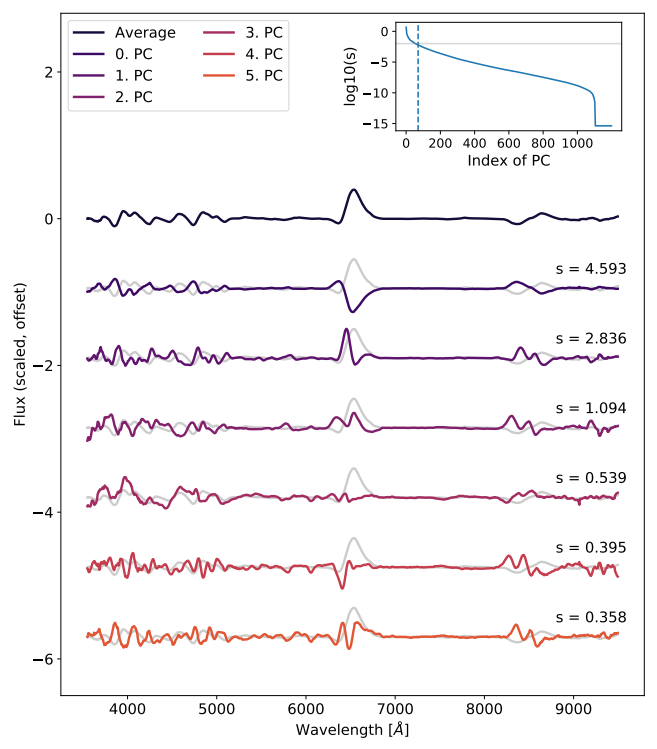
Figure 1. Principal-component analysis of the spectral time series. The dominant components capture the main axes of diversity across the Type IIP/L population and allow the sample to be studied in a compact, data-driven parameter space.
Main result
The analysis shows that Type IIP and IIL supernovae form a broad continuum spectroscopically, although some clustering remains. The dominant diversity is described by two main families: one corresponding to objects with relatively regular, well-defined P-Cygni profiles, and another with weaker or less regular features that are likely shaped by enhanced circumstellar-material interaction.
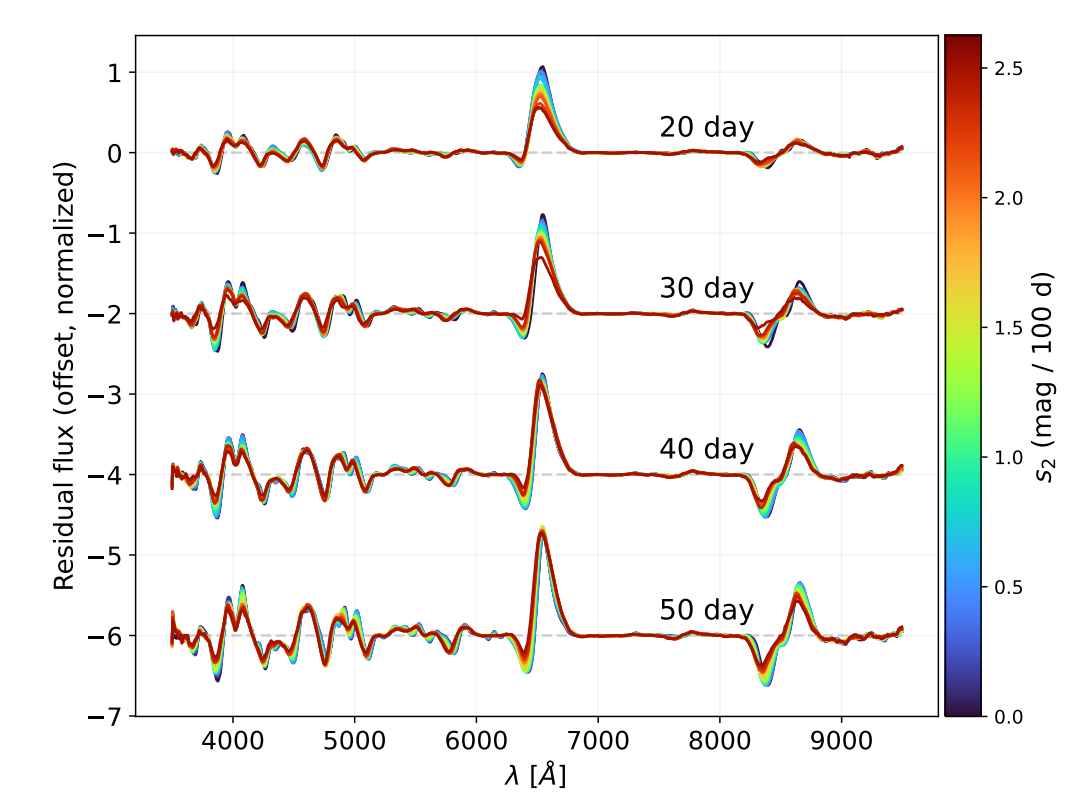
Figure 2. Spectroscopic continuity across the IIP/IIL sequence. Steeper light-curve declines are associated with weaker spectral features, while strong circumstellar interaction can perturb this trend and produce less regular line profiles.
An important outcome is that the degree of spectral diversity decreases with time. Early phases show the widest range of behaviour, while later spectra become more homogeneous. This points to physical processes near the photosphere and immediate circumstellar environment as major contributors to the observed spread.
Comparisons with radiative-transfer models indicate that neither hydrogen-envelope mass variation nor circumstellar-material interaction alone is sufficient to explain the full diversity. Both ingredients are needed. In particular, steeper decline rates tend to correspond to weaker spectral features, supporting the view that fast decliners generally have less pronounced line profiles, while stronger interaction can modify or even disrupt the classic P-Cygni morphology.
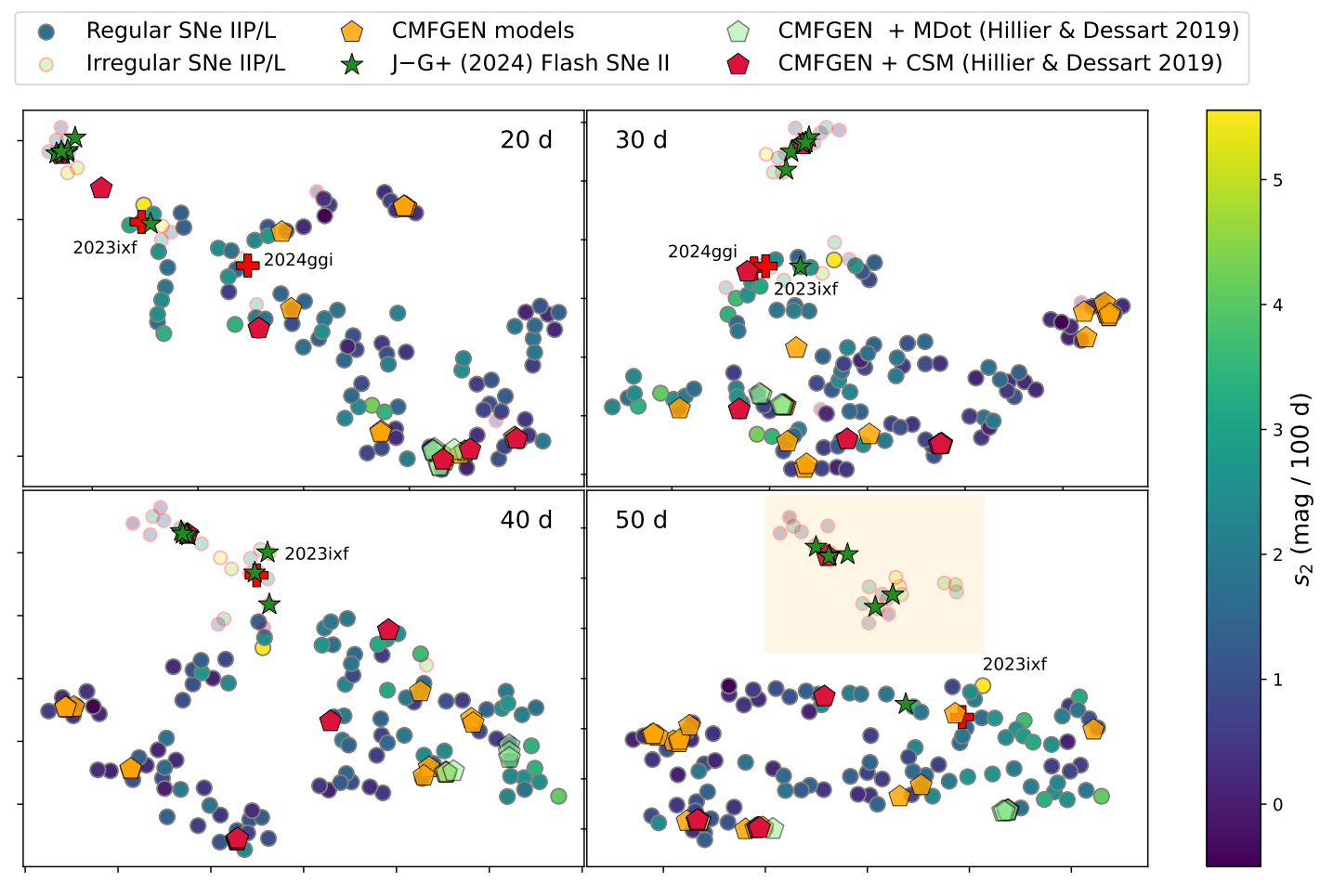
Figure 3. Clustering of the sample supernovae at 50 day epoch, along with comparison cases either from radiative transfer models or observations. Comparisons with models show that both hydrogen-envelope mass and circumstellar-material interaction are needed to reproduce the continuum of observed Type IIP/L behaviour. On the other hand, comparison with observations showed that some directions in the diversity can be explained by enhanced CSM interaction.
Taken together, these results strengthen the case that Type IIP and IIL supernovae are not cleanly separated subclasses, but rather part of a continuous distribution. Beyond the classification question itself, the method introduced here provides a compact way to quantify spectral diversity and opens the door to more refined, physically informed classification schemes for large future samples.