
AU Pegasi revisited: period evolution of a peculiar Type II Cepheid
A brief overview of the motivation, method, and principal result of this first-author paper.
Key result: AU Pegasi shows strongly non-linear pulsation-period evolution, with changes of several percent on human timescales, underscoring its highly unusual nature among Type II Cepheids.
Motivation
This paper investigates the peculiar behaviour of AU Pegasi, a relatively underexplored Type II Cepheid that belongs to one of the shortest-period binary systems known for this class, with an orbital period of only 53.3 days. Previous work had already suggested that the star exhibits irregular pulsation-period changes, characterised by intervals of apparent stability followed by rapid, accelerating evolution.
Method
The primary goal of this study was to extend and reanalyse the available photometric data in order to trace the long-term evolution of the pulsation period. This was carried out using the classical O–C (observed minus calculated) diagram framework, which provides a sensitive diagnostic of departures from regular pulsation behaviour.
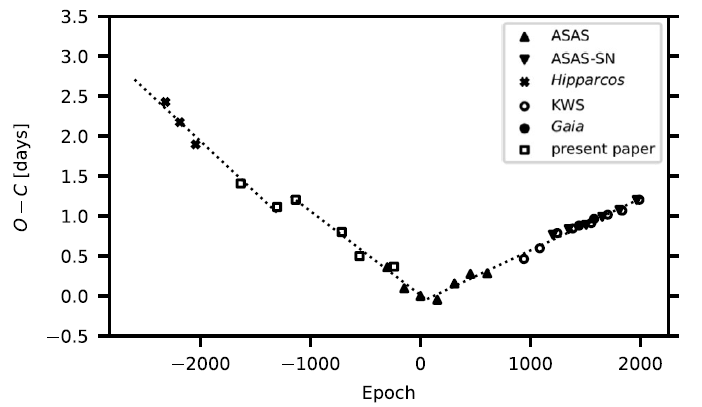
Figure 1. The O–C diagram of AU Pegasi reveals marked departures from the smooth parabolic trend expected for steady evolutionary period changes.
Main result
The resulting O–C diagram confirms that AU Pegasi deviates significantly from the behaviour expected for a regularly evolving Cepheid. Instead of a smooth trend, the diagram exhibits pronounced distortions, indicating complex and non-linear period evolution.
From this analysis, the pulsation-period evolution was reconstructed and found to be strongly non-linear and erratic. The scale of the effect is substantial: the period changes by several percent on human timescales, highlighting the exceptional character of this system.
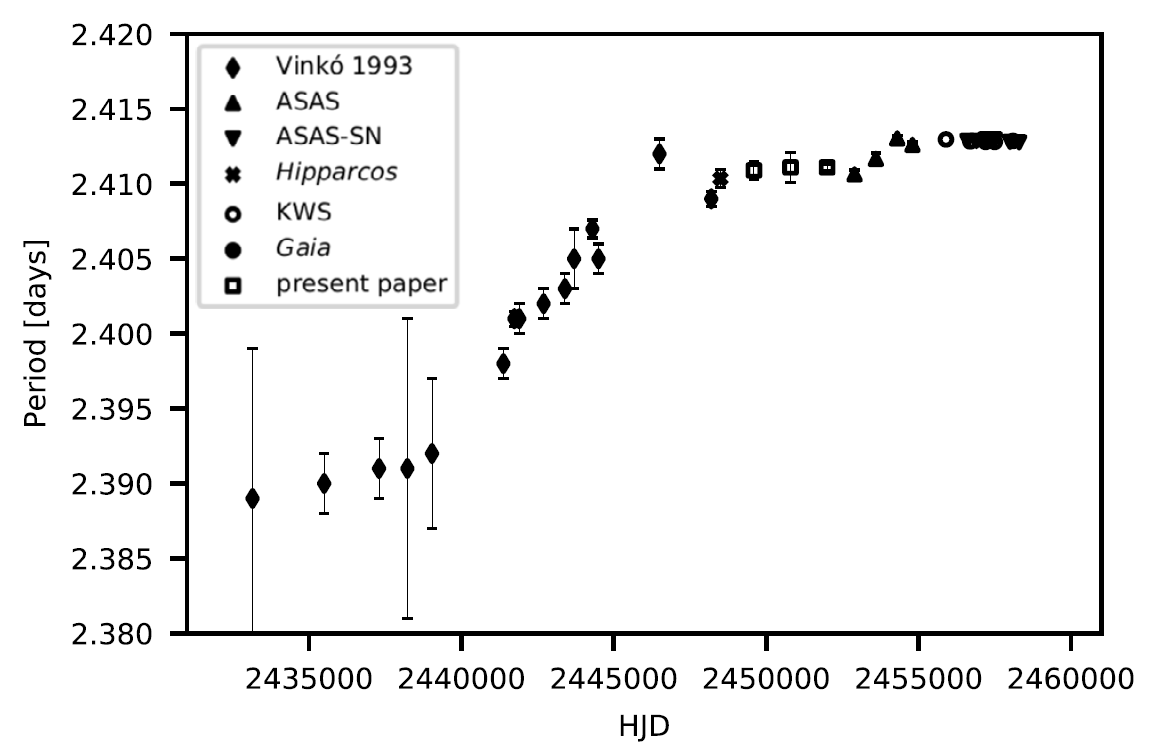
Figure 2. Visual summary of the study and the remarkable period-evolution behaviour of AU Pegasi.